Artificial Intelligence (AI) dominates headlines, promising to revolutionize entire industries and boost productivity to unprecedented levels. However, amid this gold rush, a growing number of organizations are discovering a harsh reality: despite heavy investments, AI projects fail to deliver real value. A study by the Boston Consulting Group (BCG) and MIT Sloan revealed that 90% of companies investing significantly in AI still fail to achieve measurable financial returns.
The difference between success and failure in AI adoption does not lie only in technology but in a series of fundamental errors in strategy and governance. What separates companies that thrive from those that fail is not just how they approach technology, but also how they address business complexities and the human factor.
Where Most Companies Fail in the AI Journey
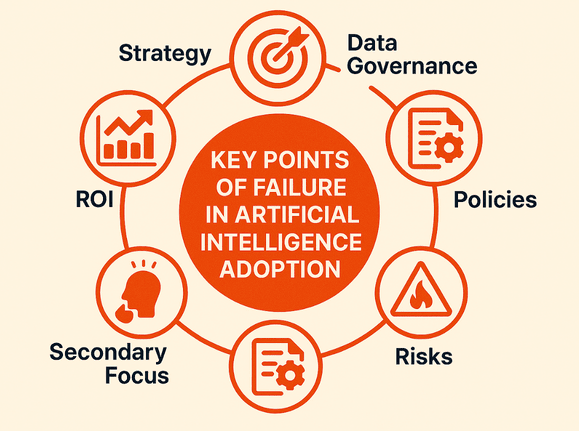
Failures in AI are rarely caused by technical shortcomings. They are, at their core, failures of leadership and planning.
Lack of Strategic Alignment with Business
Many AI initiatives start with the wrong question: “What problem can this new technology solve?” instead of “What are our biggest business challenges and how can AI help us overcome them?” The result is a portfolio of isolated technology projects disconnected from the company’s strategy. A Gartner survey points out that the lack of a clear AI strategy is the main obstacle to adoption, even more significant than talent scarcity.
Nonexistent Data and AI Governance
AI is data-hungry. Without robust data governance ensuring quality, standardization, and accessibility, models are fed inconsistent information. The principle of “garbage in, garbage out” applies perfectly. Similarly, the absence of AI governance—protocols to explain how a model reached a conclusion and who is accountable for its performance—turns complex algorithms into unreliable black boxes. A Capgemini Research Institute study revealed that 61% of companies lack a data and AI governance framework.
Absence of Clear Usage Policies
The generative AI boom exposed risks few companies were prepared for: unregulated use. Employees using tools like ChatGPT without clear guidelines may inadvertently expose sensitive data, violate copyrights, or generate content harmful to the brand. A Google Cloud survey showed that 56% of global security and IT leaders believe employees are already using generative AI unsafely.
Neglect of Risk, Privacy, and Security Assessments
This is the most vulnerable point. Companies that fail to critically assess AI risks operate in a minefield.
- Bias and Ethics Risk: Algorithms can perpetuate prejudice. According to the World Economic Forum, algorithmic bias and discrimination are among the greatest technological risks of the next decade.
- Privacy Risk: Collecting and using customer data, even minimally identifiable, without proper consent or anonymization collides with strict regulations such as LGPD and GDPR, which impose heavy fines.
- Security Risk: AI models are targets of new types of cyberattacks. Research by S&P Global Market Intelligence found that 53% of companies lack a mitigation plan against AI attacks.
Focus on Secondary Processes
It is common to see companies using AI for low-impact automation tasks, such as categorizing complaint emails. While useful, these projects generate only marginal gains. The true power of AI lies in reimagining core business processes. Priority should go to high-impact projects that create competitive value.
Lack of Value and ROI Measurement
The absence of clear metrics explains why many AI projects “disappear” after the pilot phase. When companies focus only on technical metrics (such as model accuracy) and ignore business impact, they fail to justify investments. Without a clear ROI—connecting the project to cost reduction or revenue growth—it is impossible to scale initiatives. A McKinsey & Company study revealed that while most companies implement AI, only a small fraction manage to measure ROI.
The Recipe for Success: What Mature Companies Do Right
AI leaders adopt a holistic and disciplined approach.
- Business Strategy as a Starting Point: They begin by asking, “What are our biggest challenges and how can AI solve them?” AI is a means to achieve business goals, not an end.
- Establishment of a Governance Framework: They create clear governance structures, including an AI Ethics Committee, define data security protocols, and assign accountability for models to specific people and areas.
- Ethics and Security as Pillars: Risk assessments of bias, privacy, and security are non-negotiable steps in project planning. Ethics is not just a checklist item but a design principle.
- Focus on Core Transformation: They identify business areas where AI transformation can generate disruptive competitive advantage, such as predictive forecasting in production or the development of new services.
- Building a Data Culture and Skills: They invest in AI talent but also foster data literacy and AI education across the organization—from leadership to staff—ensuring the technology is well understood and adopted by all.
Success in the AI era will not be measured by how many tools a company adopts, but by how well it uses AI to solve business problems strategically, ethically, and securely. It is a journey that requires a mindset shift, transforming AI from a technological experiment into a core business capability.a de mentalidade, transformando a IA de um experimento tecnológico em uma competência central do negócio.

Aldo Segnini is CEO of Tailor Strategy, Head of AI at beecrowd and VP of the International Association of Artificial Intelligence (I2AI). With over 25 years of experience in technology and specialization in AI-driven Digital Transformation, he works in strategy development, innovation, and leadership. He holds a Computer Science degree from UFSCar and advanced studies at MIT, Stanford, and the University of Chicago. LinkedIn