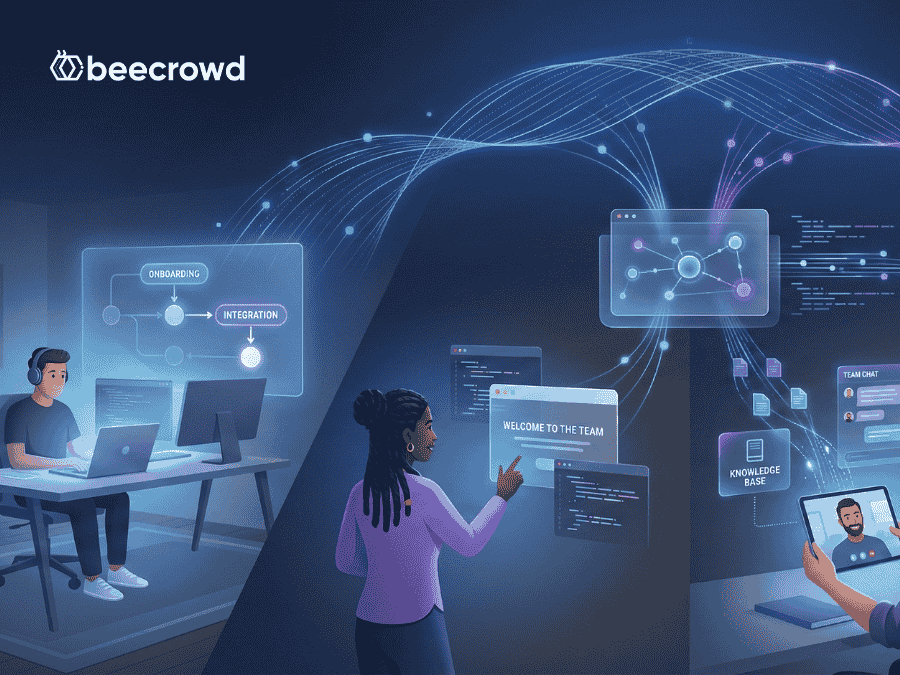
How to Turn a Challenge into a Strategic Advantage
Why Is Remote Onboarding a Critical Pillar for Tech Companies?
Remote work is no longer an emerging trend—it has become the dominant model for technology organizations operating with highly distributed and culturally diverse teams. This scenario boosts competitiveness by enabling access to specialized talent across countries, time zones, and cultures, but it also introduces new management demands.
Integrating developers remotely requires more than providing credentials, systems, or institutional manuals. It’s about creating a welcoming experience that connects people to purpose, culture, and strategic goals.
When poorly executed, remote onboarding directly impacts initial productivity, retention, and even employer branding. On the other hand, when strategically planned, it becomes a powerful accelerator for performance, engagement, and innovation.
Companies that view remote onboarding as a core talent management strategy can reduce costs, scale teams quickly, and increase global competitiveness.
Structured Planning: The Foundation for High-Performance Onboarding
Effective onboarding starts long before a developer’s first day. It involves careful planning, a well-designed journey, and organized resources to ensure a smooth process. Technical documentation, tool usage guides, internal policies, and coding standards must be clear, updated, and easily accessible.
Development environments should be pre-configured, tested, and integrated with internal systems to avoid rework and frustration. A structured agenda for the first weeks, with progressive deliverables and defined checkpoints, increases predictability and builds confidence. Lack of planning leads to delays, inefficiencies, and a perception of improvisation—highly detrimental for companies aiming to attract and retain top talent.
Communication and Culture: Building Human Connection in Distributed Teams
Keeping culture alive in distributed teams requires intentionality. Communication should be relational, not just informative. Virtual welcome sessions with leaders, presentations on purpose and values, and product and roadmap immersions strengthen belonging from day one.
Encouraging informal interactions—such as virtual coffee breaks, internal communities, and cultural events—helps reduce isolation and build trust. Assigning a mentor or buddy for the first 30–60 days is essential to guide the newcomer, provide emotional support, and ease adaptation.
In high-autonomy contexts, regular feedback and transparency in performance expectations are key pillars for engagement, alignment, and shared purpose.
Automation and Technology: Accelerating Integration and Enhancing Experience
Technology is the lever that transforms remote onboarding into an intelligent, seamless, and scalable experience. Manual processes—such as access creation, signatures, environment setup, and internal registrations—consume time and expose companies to operational failures.
Digital onboarding platforms, identity management, automated technical provisioning, continuous integration, and collaborative tools are essential to reduce friction and accelerate time-to-productivity.
Tech professionals value environments that demonstrate organization, efficiency, and digital maturity. Companies that integrate automation into onboarding reinforce their image as innovative organizations ready to operate globally.
Metrics and Feedback: Turning Onboarding into Organizational Intelligence
Like any strategic process, remote onboarding must be measurable, iterative, and results-driven. Indicators such as time-to-value, engagement rate, internal NPS, cultural integration level, and post-onboarding retention provide critical insights into process effectiveness.
Qualitative surveys immediately after integration cycles are valuable for identifying pain points and optimizing future executions. Organizations adopting this approach turn onboarding into a continuous intelligence system, improving employee experience and strengthening culture through data.
Remote Onboarding as a Competitive Advantage and Employer Brand
Remote onboarding goes far beyond HR or tech best practices. It represents a strategic opportunity for companies seeking to scale operations quickly, strengthen organizational culture, and position themselves as globally attractive employer brands. In a market where top developers have multiple options, delivering a memorable onboarding experience can determine who attracts, engages, and retains the best talent.
Companies that anticipate, structure processes, and invest in automation and culture create sustainable competitive advantage—translated into innovation, productivity, and a strong organizational identity.
Your onboarding strategy will only be effective with the right team by your side.
Connect with experienced developers and accelerate your digital transformation with beecrowd Recruiter. Boost your projects with qualified talent ready to perform from day one.
Create your corporate account on beecrowd Recruiter and turn remote onboarding into a strategic advantage. Learn more here.